The Rite of Spring

The Rite of Spring
To bookDescription
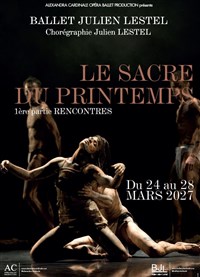
The Rite of Spring - Part One: Encounters<div> MEETINGS</div><div> The choreography opens with a simple, almost ritualistic image: 10 dancers, arranged in a circle, form a silent community. This circle, a symbol of unity and equality, becomes the starting point for a silent dialogue. Each dancer seems simultaneously present for themselves and attentive to the others.</div><div> From this shared focus, dance emerges. What began as a juxtaposition of individualities becomes a collective, fluid, and organic expression. The initial circle never truly disappears; it transforms into a living dynamic, a symbol of a community in motion.</div><div></div><div> THE RITE OF SPRING</div><div> Commissioned by the Tjibaou Cultural Centre in Nouméa to celebrate the centenary of the creation of The Rite of Spring at the Théâtre des Champs-Elysées in Paris in 1913, Julien Lestel offers his version drawing on Kanak culture. Based on Igor Stravinsky's original score, this ballet is composed of two parts, each consisting of a series of incantatory scenes and ritualistic games. The first part culminates in the intense dance of the earth, where men question the future according to ritual, and the second in the grand sacred dance where a woman is chosen to be offered to the gods.</div>