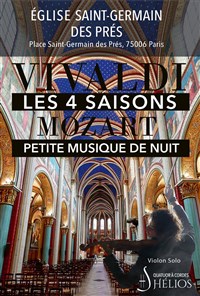
Vivaldi's Four Seasons + Mozart's Eine Kleine Nachtmusik

Vivaldi's Four Seasons + Mozart's Eine Kleine Nachtmusik
To bookDescription
Antonio Vivaldi's Four Seasons is a set of four violin concertos, composed in 1723. Program:<br> Vivaldi's Four Seasons (Complete) / Mozart's Eine Kleine Nachtmusik<br><br> Solo Violin: Glen Rouxel<br><br> This is undoubtedly Vivaldi's most famous composition and the most frequently performed piece of music in the world. It is a violin concerto for a single violin accompanied by a chamber orchestra. The content of each concerto is varied and evokes each of the seasons to which it relates. For example, winter is punctuated by pizzicato notes on the upper strings, reminiscent of icy rain, while summer evokes a storm in the final movement, foreshadowed by thunder that rumbles repeatedly throughout the movement.<br><br> The Four Seasons concertos were first published in 1725 as part of a set of 12 concertos, Opus 8, under the theme of "the confrontation between harmony and invention" (il cimento dell'armonia e dell'inventione). The first four concertos were named after the four seasons, each bearing the name of the season in question.<br><br> The Helios Orchestra: Dynamic and eclectic, the Helios Orchestra has made its mark since its creation in 2014.<br> Its artistic director, Paul Savalle, promotes the professional integration of young musicians through orchestral practice. Thus, recent graduates mingle with experienced orchestral musicians, conductors, and soloists in optimal working conditions.<br> From Baroque to contemporary music, the programs are varied. As for the repertoire, it is both symphonic and choral, with the orchestra joining forces with departmental and regional choirs.<br> Thanks to the collaboration of various conductors, the musicians tackle a very rich repertoire, broadening their interpretive range. They all come from major French conservatories, some belonging to a national orchestra.<br> From string quartets to symphony orchestras, including brass ensembles, the orchestra continually expands its audience by adapting its instrumentation. String ensembles perform in picturesque locations unsuitable for a full symphony orchestra, allowing audiences to discover a rich architectural heritage.<br> In short, thanks to its variable geometry formation, the Helios orchestra approaches the widest repertoire with passionate curiosity.