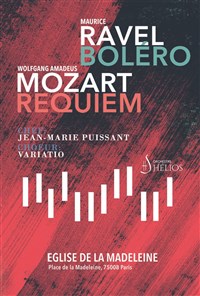
Ravel's Bolero / Mozart's Requiem

Ravel's Bolero / Mozart's Requiem
To bookDescription
Program :<br> Ravel's Bolero<br> Mozart's Requiem<br><br> Ravel's Bolero:<br> Boléro is the most frequently performed piece of classical music in the world, with a performance every 15 minutes. At the time of its creation, the composer gave the copyright to his gardener, never anticipating its widespread popularity. This work is the archetype of the ostinato. The melody is repeated in turn by the different instruments of the orchestra over a rhythmic pattern driven by percussion.<br><br> Mozart's Requiem:<br> The unusual circumstances surrounding the commission of this work, and the somewhat tragic conditions of its composition on the composer's deathbed, contribute to its legendary status. In July 1791, Count Walsegg-Stuppach, under a veil of secrecy, commissioned a Requiem from Mozart for his wife, who had died in February. Work was delayed until October due to the composer's exhaustion from working on La Clemenza di Tito and The Magic Flute.<br> At Mozart's death, the Requiem remained unfinished. In the final stages of his illness, Mozart had written the entirety of the "Requiem aeternam": from the Kyrie to the Confutatis, only the vocal parts and the basso continuo were completed. For the Lacrimosa, only the first eight bars of the vocal part and the first two bars of the violin and viola parts were written. Sketches for additional pieces have been lost. While he was bedridden, friends came to sing parts of the Requiem at his bedside. It is possible that he was visited by Salieri.<br><br> The Helios Orchestra: Dynamic and eclectic, the Helios Orchestra has made its mark since its creation in 2014.<br><br> Its artistic director, Paul Savalle, promotes the professional integration of young musicians through orchestral practice. Thus, recent graduates mingle with experienced orchestral musicians, conductors, and soloists in optimal working conditions.<br><br> From Baroque to contemporary music, the programs are varied. As for the repertoire, it is both symphonic and choral, with the orchestra joining forces with departmental and regional choirs.<br><br> Thanks to the collaboration of various conductors, the musicians tackle a very rich repertoire, broadening their interpretive range. They all come from major French conservatories, some belonging to a national orchestra.<br><br> From string quartets to symphony orchestras, including brass ensembles, the orchestra continually expands its audience by adapting its instrumentation. String ensembles perform in picturesque locations unsuitable for a full symphony orchestra, allowing audiences to discover a rich architectural heritage.<br><br> Helios Orchestra<br> Choirs: Ephemeral Helios<br> Conductor: Matthieu Cabanes The Helios orchestra approaches the widest repertoire with passionate curiosity.